
There is a logical fallacy called “the mirror image” mistake—know how you look in the mirror and your part is on the other side? A mirror image fallacy is the opposite of the logical answer. Here’s one: we believe blessing comes with obedience, curse if we disobey. That’s from Deuteronomy. When good things happen it is the blessing of God, therefore we take bad things to mean we must be cursed. When we come to difficulty and darkness in life, we do not automatically assume that this is something we have done wrong.
Yet we can make an additional mistake—we can think blessings, material or otherwise, should not be dwelt on too much, because it is not spiritual of us. First because we hear the pastor warning us about not getting too entangled in it and also because of the distortions we see. We see some attrocious theology of blessing on any of the religious networks on television, a prosperity, health and wealth gospel that says, “You got it because you are God’s special people and God’s people do better than others.” You know that isn’t true, at least materially.
This can lead us to downplay the material, the physical and this world. Dietrich Bonhoeffer once said that in reading the Psalms it is striking to see how much it is concerned with bread, life, and our fortunes in life. The more spiritual we are, the less we will be concerned with earthly matters. That was an Old Testament preoccupation that has now been superseded by a more mature, spiritual concern.
God is concerned about all of life, and everything in our lives. If materialism, the over-concern with material things, can be destructive, so too can denying our basic needs. And we can turn our blessings themselves into curses.
It is important for us to be able to count our blessings in life. Paul Harvey once said that golf is a game in which we yell, “Fore,” shoot six and write down five. I used to play regularly with a minister friend years ago in Georgia. We were mediocre golfers, a level that now I only aspire to again. Anyway, we decided to play on Labor Day, when every would-be duffer in America would be on a course. To beat the rush, we decided to get up and go early, before the clubhouse opened.
We arrived at dawn and headed out. Unfortunately, there was a heavy dew on the course that morning and every ball we hit sent a spray like a waterskier’s trail behind it. On the first hole we did not hit well, but we hit often. Labor Day was fitting for that round of golf, for the whole ordeal was a labor. When we finally reached the first green, we turned around and look behind us and started laughing. The dew had traced our pathetic efforts. The tracks criss-crossed from one rough to another.
We had not managed to hit a single ball off the fairway. Whoever came next would know how bad we were, for the paths were in front of them.
Sometimes it is only in looking back that we realize our blessings and trace our life path. Like a trail in the dew, we see our blessings and the gentle imprint of God’s guidance. He leads me in the paths of righteousness for his name’s sake.
This psalm is attributed to David and perhaps, as Eugene Peterson has suggested, it is written at the peak of David’s political and personal power. He has come to realize his destiny through his skills, his intelligence and wit, his courage and might, and his determination. But he also recognizes that alongside these qualities, he has been blessed by God. Like Israel itself, David realized in tracing his life path the many ways that he had been the beneficiary of God’s graciousness.
At the heart of this truth is the recognition that God has done some things for us. And David uses two beautiful images about God—that God is shepherd and that God is host. At their heart they imply the same truth that we will see.
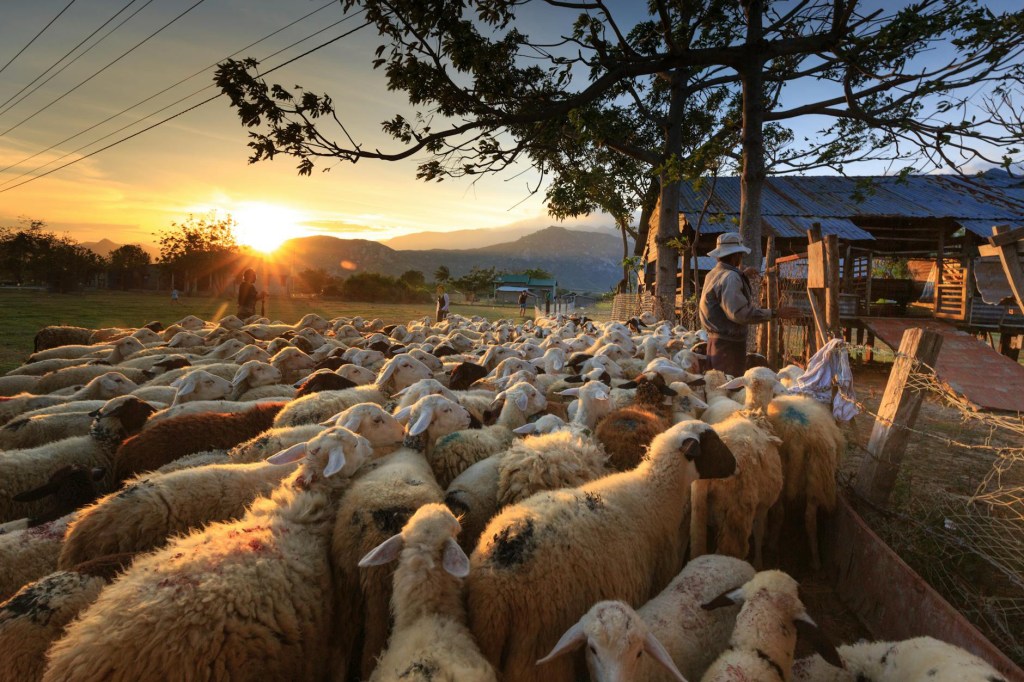
Shepherd is an old familiar image in the church. Jesus is the Good Shepherd. Like so many things, of course, it has become sentimentalized and distanced from us because we have little or no contact with that reality anymore. Our food comes packaged and wrapped for us. We don’t know any sheep on a first-name basis.
David talks about God’s provision in leading, guiding, providing and protecting the sheep. There’s a reason for it.
A pastor named David Roper writes:
It occurs to me that if Jehovah is to be our shepherd, then we have to begin by recognizing that we are sheep. I don’t like that analogy, frankly, because I don’t like sheep. I come by my dislike honestly. I used to raise sheep. In high school I was in the 4-H club, and I had a herd of sheep and goats. Now goats I can abide, because they may be obnoxious, but at least they’re smart. Sheep are, beyond question, the most stupid animals on the face of the earth. They are dumb and they are dirty and they are timid and defenseless and helpless. Mine were always getting lost and hurt and snake-bitten. They literally do not know enough to come in out of the rain. I look back on my shepherding days with a great deal of disgust. Sheep are miserable creatures.
And then to have God tell me that I am one! That hurts my feelings. But if I am really honest with myself I know it is true. I know that I lack wisdom and strength. I’m inclined to be self-destructive. As the song says, “I’m prone to wander.” Isaiah said it best: “We are all like sheep who have gone astray; we have turned every one to his own way,” {cf, Isa 53:6}. I know my tendency toward self-indulgent individualism, going my own way and doing my own thing. That’s me. I’m a sheep. And if Jesus Christ is to be my shepherd, I have to admit that I need one. It is difficult, but that is where we must start. Once we admit that need we discover the truth of what David is saying. We shall not want.
In Palestine, water and grazing areas are in short supply. The sheep were utterly dependent on the shepherd to survive.So many of the reasons for human pride depend on natural advantages—intelligence to use the system we are in, natural talent, right place at the right time, but to have a right relationship with God means to acknowledge this fundamental dependence.
Sheep are afraid of running water; they will drink only from a quiet pool. A good shepherd, particularly in a semi-arid region such as Palestine, knows where the watering holes are.
Modern people, of course, have trouble thinking of themselves this way—as afraid, vulnerable, dependent. Everything in the way we live life is aimed at getting as far from that as possible. Yet even in this very independent society, we keep running into the walls of things we can’t whip.
Our resources are extraordinary, yet we also have become aware that we live on a fragile planet spinning in the universe. We use up our resources as though they go on forever, yet we know that they are finite.
We face choices and those choices have implications. Many, unfortunately, are beyond our knowing. If I take this job and move, will this be the stress that overwhelms my marriage or the opportunity of a lifetime? If I pass it up, will I live to regret it?
There is the classic story about a man undergoing basic training in the army. He was pulling KP and was given the assignment of sorting potatoes. There was a huge mound of them and the mess sergeant told him to put all the bad ones in one bin, and all the good ones in the other bin. He came back about two hours later to find the man just looking at one potato. There was nothing in the bins. The sergeant said, “What’s the matter, don’t you like the work?” The soldier said, “It’s not the work; it’s the decisions that are killing me.”
We also learn again and again in life that we cannot put ourselves permanently in a place of security. Someone was telling me this week about a mission trip they were going on to South America. They will provide a medical clinic in one of the most dangerous cities in that country. It is a section so dangerous that the police will not even go there. The missionary there has an agreement with the gang lords who rule it that they will guarantee their safety for one week while they are there to minister.
We do not always feel the sense of vulnerability because many of us have done well enough to put a buffer between ourselves and starvation. Yet we depend for our security on an economy, a complex social service and business system, a powerful police, military, and legal system, and a functioning infrastructure and a web of mutual social values to enable this lifestyle. It holds up, but it is in some ways it is always fragile. We live under the tension of burgeoning immigration, growing population, increasing energy consumption and materialism. It has a price.
Sometimes in traveling this goes away. I was in Cairo, Egypt in the 1980s on a cheap preacher’s tour. We stayed at the Holiday Inn Pyramids, I saw a Kentucky Fried Chicken, and I wrongly began to think, “It’s not all that different here.” Within a few months after we were there, I read in the newpaper the soldiers we had seen standing majestically at attention to insure our security, rioted and burned our hotel to the ground.
I felt it last year when I left the rest of our mission group at the hotel in Satu Mare, Romania and went an hour’s drive with three strangers to speak at the church. I felt this terrible vulnerability. We were flying down a road in a strange country where I did not know the language. What if we had a wreck? You are dependent.
This vulnerability can be hidden from us but not forever. We work hard to locate ourselves securely, but when we drive in a strange city and get lost in a rough section of town we can feel it. We lose our job or get downsized or outsourced or outdated or whatever other way companies say, “We don’t need or value you here anymore. You are a liability.” And suddenly you tumble down the slope of security and the world looks dangerous.
You can feel it when physical illness strikes and your health is endangered. Then you realize what an amazing thing it is to just feel good and wish you could again. You are completely dependent on the healing process to bring you to health again. Aging brings so much of this to us—at the beginning of life we are dependent on others to meet our needs, but sometimes at the end of life too we return to that place, and it is a hard place to be.
God is also the gracious host. This may not seem such a significant image to us, but it is strikingly different in the middle east. We southerners are probably more in touch with this because we have strong codes of hospitality. I think that’s because we are people so touchy and territorial—where else do you have so many feuds, codes of honor and all that? Hospitality keeps us from killing each other.
In the middle east, when a stranger or a foreigner came to someone, they were absolutely obligated to feed, house and protect them from harm. Because of their code of honor, even if someone’s enemies pursued them, if they were under the roof of an Israelite and being fed at his table, the enemies could only look in the windows and gnash their teeth.
God is our host. This is God’s world and we are his guests. When we come to the Lord’s table to celebrate communion, we remember that. We are here not by resume but by invitation and hospitality.
Today is anniversary. Look back and see all we’ve been through as a church, all the people who have been touched by this church and its ministries. As a church, we are undertaking a huge enterprise in our building and landscaping plans. You can see the model in the hallway. We look back at the “wagon tracks” and trace God’s loving and grace-filled guidance, even when we didn’t know it. “He leadeth me, he leadeth me, by His own hand he leadeth me.”
“I will dwell in the house of the Lord forever.” Seems to be almost like, “And they lived happily ever after.” One commentator I read said, “This can also be translated, “I will return to the house of the Lord to live.”
One way to think of our blessings is a kind of self-congratulations about how blessed we are, how good life is, and how wonderful life has been. It is appropriate to do that from time to time, to look things over and say, “We have had it good.”
But maybe it also invites us to consider the permanent invitation to choose to dwell with the shepherd, host. Our way was prepared. We were protected during danger. We were blessed with merit. We were invited to stay. Sheep, you are blessed indeed, by a Good Shepherd. Sometimes, only when you look back, do you remember to be amazed.


Beautiful
Heard Paul Simons 7 Psalms yet? I encourage it
Bruce Downs
Bruce Downs CPA
3349 Independence Drive
Suite 100
Homewood, AL 35209
205-879-8080 ext 100
Fax 205-879-6864
Read Our Latest News below:
https://conta.cc/4jtn2wh Including the new 2024 Tax Organizer
LikeLike