Stories and tales from a guitar-picking writer, theologian, speaker, blogger and entertainer. From small town quirks to the bizarre realities of family, whacky church life and slightly damaged kinfolk, insights from a reluctant son of the South takes you along. Never know where it’ll end up but it’s sure to be worth the trip.
Henry Francis Lyte was an Anglican priest who originally intended to be a doctor, but then entered the ministry. He was a prize-winning poet during his university years, and best known for his elegant hymn, “Abide With Me.” He continued to write religious poetry through his life. He was born in 1793 and died when he was only fifty-four years of age. The first verse captures a transcendent and haunting mood: “Abide with me; fast falls the eventide; The darkness deepens; Lord, with me abide. When other helpers fail and comforts flee, Help of the helpless, O abide with me.” … Continue reading Abide With Me
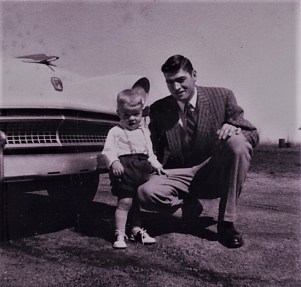
…and you did, if you’re still standing in this world. Mine is a good man, who worked hard, because that’s what a real man did for his family. He had one little boy, then another, and a third, and finally my mother got an ally, my baby sis. Dad was a basketball star, a talented carpenter and cabinetmaker who built our first house with his own hands in his “spare time.” If he was quiet, he was affectionate and a mountain to aspire to as a child.
Dad and me, 1958.
We wanted to be like him. We were in awe of him, And he was there, always there. Even if he traveled, he always came back. Not all Fathers live up to that, but if they don’t, they aren’t really Fathers. The fathers God gives always show up, hang in there, are there for you. Yours might have been Uncle Joe or Grandpa or somebody you weren’t related to, but they always came back.
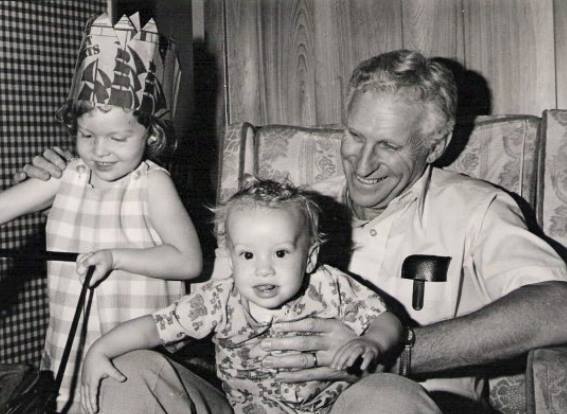
My wife had a father like that—engineer, Dale Carnegie graduate, never came out of the room without being dressed for work at the mill. No complaining, no excuses. If it’s hard, overcome it. If it’s broken, fix it. If you can pay for it, it isn’t a problem. We’re in this world to do for others, not ourselves.
My father in law, Forrest Johnson, with my two oldest girls.
These two men, along with a pretty long list of men who “fathered” me in sports, church and school, grandfathers and neighbors and Sunday School teachers, fathered me. “Fathering,” to me is this: you take responsibility for the people you love.You protect the weak. You help and defend the helpless. You stand up for what’s right and mend what’s wrong.
Fathering means helping little boys and girls know what a good man acts like. It means sacrificing, working, helping and coaching. It means helping them grow up when you’re still growing up yourself. It means doing whatever you can for your children because they come first.
If you had a father, and if you’re functional, you did. Even if that father wasn’t your biological Dad. If a man adopted you, looked Continue reading “If You Had A Father….”
This morning, I pulled on my clothes at 5:30 am and headed to the hospital to be with a member going into surgery. It took me back to August of 2001 when my “baby” sis had breast cancer. I wasn’t pastor that day. I drove to Atlanta, took the day off, and went to be with my family as she fought the toughest fight of her (maybe any of our family). She is 12 years my junior, and I left home for college when Amy was only 5. I adored her more like a doting uncle than a brother, although as adults I have loved her as a peer. She is smart, lovely, and, it turned out, a fighter. She went through it, survived, and is going strong. Still, I went back to that day, years ago, when I sat, helpless, in a waiting room, unsure what the coming hours would bring. It taught me some lessons.
Wednesdays are usually the busiest day of the week for me—surpassing even Sundays. Last week, though, Vickie and I spent the day where so many of our members find themselves at one time or another—in the waiting room. As we awaited my sister’s surgery, I found myself in the unusual position of being the recipient of visits.
As a family we had gone through all the decisions, phone calls, prayers and anxiety that patient families do. Now the day had come and we had to—wait. Here are some of the lessons I learned for just one day.
The greatest enemy in the waiting room is boredom. You talk, laugh, tell stories, and every now and then find yourselves staring at each other, waiting for something else to say. Long periods of blanking it out interspersed with imagining “in there.”
There are so many feelings for just one day. Fear stops by in the morning and pops back in when you least expect it. Hope, love, frustration, weariness, impatience and irritation. They all pass through. All you can do is sit while they fly through your brain.
People have truly different ideas of what the phrase “Dress appropriately” means.
Family, friends and church members are a comfort. You don’t have to say much. Just seeing a face and knowing a connection does something for you. All day long people I hadn’t met from her church came by and said, over and over in a dozen ways, “We care about you.” It was truly humbling. Many friends came by, and two graciously gave us over an hour of their busy lives to sit and help us laugh the time away. Three church staff came to comfort us, and they did.
It is neat to just be “her older brother from out of town.” No tie.
Hospital food must come from a single warehouse. I had the same thing I ate the last time I had a hospital meal. Some of the vegetables seemed to be prepared to drum up extra business for the gastro unit. (Editor’s note: this is better now)
Time is timeless in a hospital. That explains why nothing starts when it is scheduled and why things go on longer than you were told (reminded me of the little Catholic boy who visited a Baptist church with his buddy for the first time. “What does it mean when the preacher takes off his watch and lays it on the pulpit?” he asked. “Don’t mean anything at all,” sniffed the Baptist boy.) It is why surgery feels like eternity when you are waiting on it.
You overhear some really interesting conversations. Over in the corner a man from Jamaica recited the entire genealogy of his family to two kinswomen, loud enough for us to hear intermittently. “No, no, no, you’re Uncle Elias, see, he was my brother’s cousin…” That went on for two hours, forming a Caribbean Book of Chronicles until they finally, I think, got back to the present day. I believe the conversation only started with a single question about a nephew. “Sorry I asked,” I imagined them saying as night fell.
There is plenty of time to think about important things—how much you love the important people in your life, how wonderful the church can be when the chips are down, what really matters in life, and how connected we all are.
There are a lot of people in trouble in this world. People from everywhere. People who wouldn’t say hello to each other on the street smile and ask each other how it’s going.
Thinking about my friends back home praying for us helped. God truly is with us, even in the waiting room.
2017 update: In the waiting room, you are all the same. Democrat, Republican, affluent suburbanite, poor rural family, educated and street smart, old and tired and toddlers rambunctious. We are one in our waiting. Too bad we can’t keep that in us when we go home. The man next to me is worried about his wife, the lady over there and her friend are laughing, someone else praying. If we all hang in there, we’ll get through the day. Wait. Pray. Hope.
Yesterday I listened to an NPR story on the radio in my car about Noel Anaya. According to the piece on their website Anaya was just a year old, he and his five brothers and sisters were placed in the California foster care system. He has spent nearly all of his life in that system and has just turned 21. In California, that’s the age when people in foster care “age out” of the system and lose the benefits the system provides. That process becomes official at a final court hearing. Anaya, along with Youth Radio, got rare permission to record … Continue reading A Prayer for Parents and Children
So, then, to continue from my last post, If we are not to grieve as those who have no hope, and not to hope as those who have no grief, then only one conclusion is left to us. We should grieve as people of hope—so what does that mean?
Here is where grace enters in powerfully. “Grieving as people of hope” means that God’s grace is in the picture with us as we sorrow in life. Grace does not magically take away our pain or make it hunky-dory wonderful. I have heard preachers stand up and talk about heaven and hope in a glib and superficial silliness that emotionally slaps the faces of the grieving ones sitting in front of him or her. If it gives them a moment’s comfort, the dark shadow will soon come. If Jesus wept over Lazarus, there is something important in it for us as well. Whatever we believe about the life to come, it is always in faith, in part, clouded by the contrast between the only reality we know with some certainty against a promise that is yet to be.
Paul helps us in a second passage from the New Testament. In 2 Corinthians 4:7-9 he wrote, “But we have this treasure in clay jars, so that it may be made clear that this extraordinary power belongs to God and does not come from us. We are afflicted in every way, but not crushed; perplexed, but not driven to despair; persecuted, but not forsaken; struck down, but not destroyed; Afflicted but not crushed.”
Perplexed but not driven to despair
Persecuted but not forsaken
Struck down but not destroyed
What sustains us in life is not to escape affliction, questions, persecution and suffering. It is being rooted in the life that transcends it. This means accepting
The reality of death—as well as the truthfulness of grace. It not only does not avoid the worst features of human life, it enters into them. Grace is seeing the worst about us and still loving us. I once wrote a song to try to express the anguish of this, called,
The necessity of grief— Grief is part of life just as death is on its path. If we are to imbibe life as a gift, we have also to taste its bittersweet transience. In the nineteenth century, Ray Palmer wrote the great hymn, “My Faith Looks Up to Thee,” and penned these wonderful words:
When ends life’s transient dream, When death’s cold sullen stream shall o’er me roll; Blest Savior, then in love, fear and distrust remove; O bear me safe above, a ransomed soul!
I have written about 110 songs at this point, bits and fragments of maybe 250 more, but looking over them, I realize how much time grieving has occupied in my mind. I am sure much of this has to do with my vocation–I cannot avoid walking through the valley of someone else’s shadow weekly–but I am also impressed with the massive energy spent on avoiding the subject in our culture–and the price we pay for it. One song on this subject for today, “Trying to Remember”Continue reading “Death Grief and Hope: Songs for the Shadows (2)”


 The Flatpickin' Pilgrim's Progress