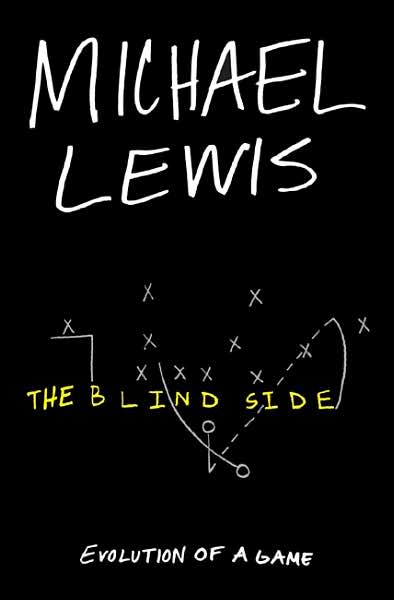
“The Blind Side” Gets Blindsided

We prefer a safe mediocrity to a persuasive truth telling.

Baptist news wires recently carried the story about a successful protest by a Baptist preacher to remove a movie from Lifeway stores.  The movie is “The Blind Side,” starring Sandra Bullock.  It was based on the book by the same name by Michael Lewis, who also wrote, Liar’s Poker and Moneyball.

Michael Lewis

I happened to meet Michael Lewis years ago when he was writing the book, and he told me he was working on a “really interesting story.”  It was about a young man from the meanest streets of Memphis who was adopted by a family and placed in a white private Christian school.  The story is well known by now—Michael Oher went on to be a football star at the University of Mississippi and now plays for the Baltimore Ravens.

I bought and read the book when it came out, and went to see the film.  Football movies are pretty well required viewing in Alabama.  So I was more than amused with all the other moral problems at the moment—debt, wars, racism, the disintegration of families, and do I need to go on?—that a PG-13 movie could cause such an uproar.  According to the report,

LifeWay Christian Stores will no longer sell videos of “The Blind Side” after a Florida pastor proposed a resolution for next week’s Southern Baptist Convention annual meeting protesting the sale of a PG-13 movie that contains profanity and a racial slur…[the stores decided to] pull the movie, an inspirational film starring Sandra Bullock that tells the true story of a white Christian family that adopted a homeless black teenager who went on to play in the NFL, to avoid controversy at the June 19-20 SBC annual meeting in New Orleans.  [The pastor who brought the resolution] said there is much about the film to be commended, but there is no place in a Christian bookstore for a movie that includes explicit language that includes taking God’s name in vain.

I get it.  It’s Baptist to speak your mind.  I know language has become debased and misused.  And, it’s the right of any store and its owners to sell or not sell what it wishes.  Still, it stirred a few thoughts about the mostly non-existent tie between Christians, especially evangelical ones, and the world of the arts.  And why fewer people want to be Baptists.

Walter Brueggemann once said that in the book of Leviticus, which for some odd reason has become a moral center for a lot of people today, there is an emphasis on holiness as “purity.”  There are other forms of holiness in scripture—moral and ethical righteousness, for one, that sometimes comes into conflict with the notion of purity.  Jesus encountered this among the Pharisees, who could not do the deeper right things for fear of disturbing their own ethic of remaining personally removed from what might compromise, taint and violate their ethic of purification holiness.

I have thought a lot about Brueggemann’s distinction since I first read it.  Somehow, a fully biblical notion requires more than avoiding “impurities.”  Yet purity is important.  An obsession seems to lead always to a rather puny moral energy that dispirits more than it inspires.  Inevitably, it ends up with an account of morality that is always boycotting, removing itself from sinners and sin, and circling the wagons.

Continue reading ““The Blind Side” Gets Blindsided”

Think Globally Listen Locally

Corporations are not necessarily evil in and of themselves, but the net effect can be the disappearance of everything that makes the place where you live distinctive. Got a notice from my friend Steve Norris that our friend Dale Short put us on his “Music From Home” radio program yesterday.  (LISTEN) (SMA is on the first program) Thanks, Dale!  “Music From Home” is local artists.  I appreciate that there are still programs here and there in a world in which globalized corporate mass culture (which is short for “controlled by a few people who are not always interested in the … Continue reading Think Globally Listen Locally

Doc, Doug and Earl…Bluegrass Goodbyes

A few days ago, I wrote about the too-soon loss of Doug Dillard, an extraordinary banjo player who was a bridge figure between Bill Monroe and the “pure bluegrass” (which is itself an irony, since Monroe was actually an innovator himself.  He took a hodgepodge of what is ssometimes called “old time music,” consisting of fiddle tunes for dancing, old folk tunes, blues and other music that flowed from Appalachia and the south and forged a unique sound dominated by the mandolin and banjo and fiddle.  He was not beyond experimenting himself, even bringing an accordion in a time or … Continue reading Doc, Doug and Earl…Bluegrass Goodbyes

Doug, Doc and Earl…Bluegrass Breakdown and Cry

The Darling Boys are no more This has been one of the unkindest of years in acoustic music.  First, Earl Scruggs, the Founding Father of bluegrass banjo, passed away (read my post on Earl’s death here CLICK)  back in March.  Then a few weeks ago, Doug Dillard, a rollicking banjo player who blazed a trail with the banjo across genres in the 1970s when he left the Dillards to join Gene Clark of the Byrds to form Dillard and Clark. Of course, you’d know old Doug for another reason, if you ever watched the Andy Griffith Show.  He was the … Continue reading Doug, Doc and Earl…Bluegrass Breakdown and Cry

The Songs Remember When Part II by Gary Furr

…there are aspects of humanity that are not reducible to particles, chemicals and rational analysis. In my last post, I reflected on the interesting work of Oliver Sacks on memory.  A few further thoughts about the whole notion of science, faith, and humanity. Sacks has been criticized roundly for his “anecdotes” that don’t meet all the rigor of some scientific requirement, especially by the radical reductionists.  Some believe that  “there is no self or soul.  We are merely the product of our acculturated experiences and brain physiology and when it’s gone, so are we.” But there is something instinctive that … Continue reading The Songs Remember When Part II by Gary Furr