Death Grief and Hope: Songs for the Shadows (2)

So, then, to continue from my last post, If we are not to grieve as those who have no hope, and not to hope as those who have no grief, then only one conclusion is left to us.  We should grieve as people of hopeso what does that mean?

Here is where grace enters in powerfully.  “Grieving as people of hope” means that God’s grace is in the picture with us as we sorrow in life.  Grace does not magically take away our pain or make it hunky-dory wonderful.  I have heard preachers stand up and talk about heaven and hope in a glib and superficial silliness that emotionally slaps the faces of the grieving ones sitting in front of him or her.  If it gives them a moment’s comfort, the dark shadow will soon come.  If Jesus wept over Lazarus, there is something important in it for us as well. Whatever we believe about the life to come, it is always in faith, in part, clouded by the contrast between the only reality we know with some certainty against a promise that is yet to be.

Paul helps us in a second passage from the New Testament. In 2 Corinthians 4:7-9 he wrote, “But we have this treasure in clay jars, so that it may be made clear that this extraordinary power belongs to God and does not come from us. We are afflicted in every way, but not crushed; perplexed, but not driven to despair; persecuted, but not forsaken; struck down, but not destroyed; Afflicted but not crushed.”

  1. Perplexed but not driven to despair
  2. Persecuted but not forsaken
  3. Struck down but not destroyed

What sustains us in life is not to escape affliction, questions, persecution and suffering.  It is being rooted in the life that transcends it. This means accepting

  1. The reality of death—as well as the truthfulness of grace. It not only does not avoid the worst features of human life, it enters into them.  Grace is seeing the worst about us and still loving us. I once wrote a song to try to express the anguish of this, called,
  2. The necessity of grief— Grief is part of life just as death is on its path. If we are to imbibe life as a gift, we have also to taste its bittersweet transience.  In the nineteenth century, Ray Palmer wrote the great hymn, “My Faith Looks Up to Thee,” and penned these wonderful words:

When ends life’s transient dream,
When death’s cold sullen stream shall o’er me roll;
Blest Savior, then in love, fear and distrust remove;
O bear me safe above, a ransomed soul!

I have written about 110 songs at this point, bits and fragments of maybe 250 more, but looking over them, I realize how much time grieving has occupied in my mind. I am sure much of this has to do with my vocation–I cannot avoid walking through the valley of someone else’s shadow weekly–but I am also impressed with the massive  energy spent on avoiding the subject in our culture–and the price we pay for it. One song on this subject for today, “Trying to Remember” Continue reading “Death Grief and Hope: Songs for the Shadows (2)”

Exploring the Discography of Life

“…there is a playful randomness about what we find and read.  Or rather, what finds us”

When I first rekindled my interest in songwriting and music again, sixteen or seventeen years ago, I began hanging out in music stores, playing the guitar again and digging out songs from my memory and on faded notebook paper from years ago.  One day, a worker in the store I frequent most, Fretted Instruments of Birminghm, said, “Are you just starting to explore the discography?”  I had just said that “I was getting into bluegrass music” and that was his reply.

I began to delve into just that—listening, going to shows, scooting to Nashville now and then.  I bought a collection of Bill Monroe’s music.  Over the coming years, I heard a lot of music live—Bruce Hornsby, Ricky Skaggs, Nickel Creek, J. D. Crowe, Earl Scruggs, Vince Gill, as well as a lot of lesser-known but excellent players and singers coming through the Station Inn in Nashville or here in Birmingham, Continue reading “Exploring the Discography of Life”

Mapping the Bluegrass Genome

“The genetic code of bluegrass and old time music is more sophisticated than that.  It carries stories of birth, life and death in the old days.  It tells of children dying young, tragic love, shame, murder, alcoholism and faith.  To learn the code, no stereotype will do.  You have to descend into the music and listen.”


In 2005 I took a three month sabbatical to study, pray, and feed the senses.  I went to art museums, read books, went to Nashville to learn about the music industry and played at open mic at the Bluebird Café, reaching one

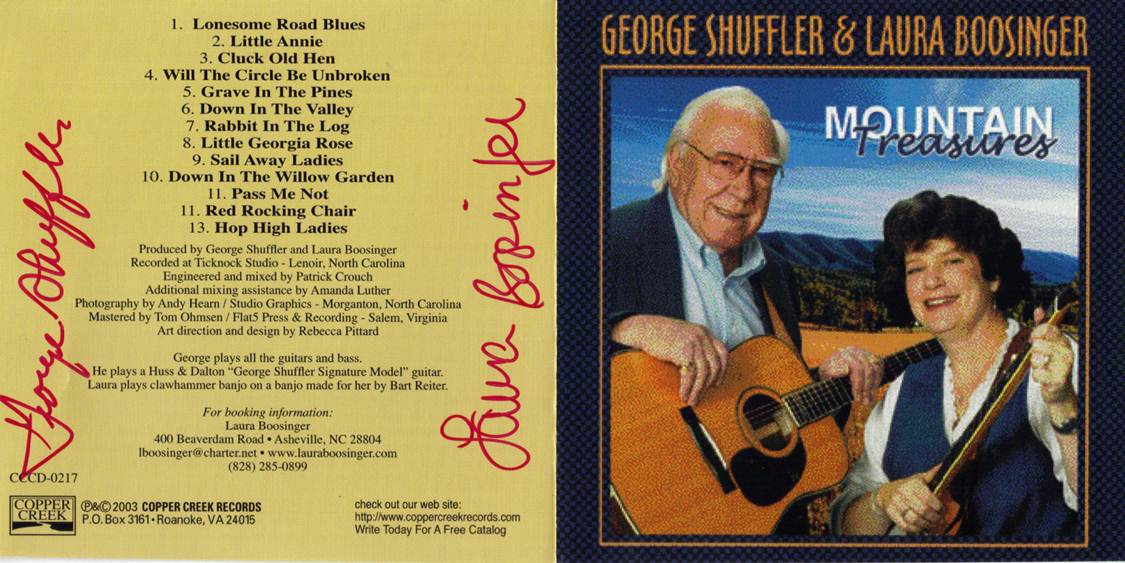
Shuffler and Boosinger Shuffler and Boosinger

of my bucket list items (the ultimate would be a gig on the “Prairie Home Companion Show” while Garrison Keillor is still on earth!).  But a lot of that time was “exploring my roots,” musical, theological and spiritual—which led to a week at Steve Kaufman’s Acoustic Kamp.

I’d been to the Kamp before, in Maryville, Tennessee.  Unless you are a devotee of the guitar and acoustic cousins like the mandolin, the “fiddle” (violin played a certain way), bass, banjo or dobro, you don’t realize that hundreds of camps happen every year across the world where musicians gather and play and learn the heritage of “roots” music—folk, jazz, country, celtic, and so on. In these places, campers rub shoulders with the legends of bluegrass, swing, fingerpicking and new acoustic music.  I met legends like Bill Keith, Clarence White, Continue reading “Mapping the Bluegrass Genome”

Fiddle Tunes, Old Time, and “Jamming”

When you jam, you shoot for fun and participation, not showing off Well, the other day Nancy called me and said, “Hey, we’re going to have a jam over at the house.”  Jim Brown and his daughter are coming to play fiddle, and a couple of neighbors are coming, one plays the guitar.”  So I went.  We had a grand time. Jam sessions used to terrify my when I was still learning the “discography,” as they say.  The bluegrass, celtic, Irish, old-time and folk worlds are an oral tradition of literally thousands of songs.  Just the familiar American fiddle tunes … Continue reading Fiddle Tunes, Old Time, and “Jamming”

Doc, Doug and Earl…Bluegrass Goodbyes

A few days ago, I wrote about the too-soon loss of Doug Dillard, an extraordinary banjo player who was a bridge figure between Bill Monroe and the “pure bluegrass” (which is itself an irony, since Monroe was actually an innovator himself.  He took a hodgepodge of what is ssometimes called “old time music,” consisting of fiddle tunes for dancing, old folk tunes, blues and other music that flowed from Appalachia and the south and forged a unique sound dominated by the mandolin and banjo and fiddle.  He was not beyond experimenting himself, even bringing an accordion in a time or … Continue reading Doc, Doug and Earl…Bluegrass Goodbyes