Stories and tales from a guitar-picking writer, theologian, speaker, blogger and entertainer. From small town quirks to the bizarre realities of family, whacky church life and slightly damaged kinfolk, insights from a reluctant son of the South takes you along. Never know where it’ll end up but it’s sure to be worth the trip.
In the book of 2 Kings 23:10 we read of a defiled valley in Jerusalem where child sacrifice had been practiced through burning. King Josiah, in his reforms, declared it a defiled place. According to 2 Chronicles. 28:1-3, King Ahaz had offered incense there and offered his sons as a sacrifice. It was considered accursed, a desecrated place. So, too, King Manasseh, the wicked King who turned his back on the faith by permitting the horrific practices of other religions (although leading the nation to a prosperous economy) to be allowed, including child sacrifice. occultism, witchcraft and sorcery, channeling and … Continue reading The Valley of Hinnom
Henry Francis Lyte was an Anglican priest who originally intended to be a doctor, but then entered the ministry. He was a prize-winning poet during his university years, and best known for his elegant hymn, “Abide With Me.” He continued to write religious poetry through his life. He was born in 1793 and died when he was only fifty-four years of age. The first verse captures a transcendent and haunting mood: “Abide with me; fast falls the eventide; The darkness deepens; Lord, with me abide. When other helpers fail and comforts flee, Help of the helpless, O abide with me.” … Continue reading Abide With Me
Today I am beginning a series of blogs about songs, more specifically songs I have written. I want to write a little about their “births,” as for me, songs are like children, or at least like the ugly ash tray I made out of clay at camp. They are mine, they mean something to me, and I still love singing them. Today, I’ll start with the first cut on my new album, “Down in Bethlehem.” I actually came up with the idea while writing a sermon, I guess it was during Advent of 2015. It’s a bit weird, really, to think of a third of humanity gathering every week to reflect on a two thousand year old set of texts, but in a time when we obsess over the latest thing, it’s a little comforting to me that we can mull over the same writing again and again, and like some prism being slowly turned in daylight, new colors of insight come.
I was struck by the commonality of the major stories about Bethlehem, that of Ruth, a Moabite widow who came as a foreigner immigrating back to her husband’s home’ David, the youngest of eight, who was selected by the prophet Samuel to replace Saul as king, and Jesus, born to a young couple shrouded in unimportance. Again and again, in the Bible, God “chooses” to work with the “Most Likely Not to Be Chosen.” First I wrote a short poem to use in the sermon, then was haunted by it until this song came.
I was thinking about U2, Springsteen, music that is simple, driving, repetitive and building over time. Brent Warren does some really fine electric guitar work on this cut. Take a listen and enjoy! BUY or listen to it here. It still is true, I believe, that hope is a powerful and inexplicable reality, one that rises up unexpectedly and in the most unpromising of moments. That is when I suspect God might be up to something. (see Ruth, 1 Samuel 16, Matthew 2 for the stories behind the song). I’ve posted the whole song on my website for a week or so. https://www.reverbnation.com/garyfurrmusic
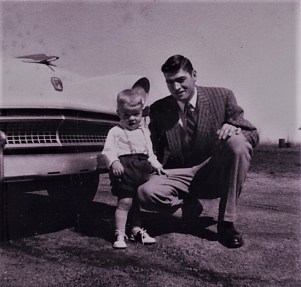
…and you did, if you’re still standing in this world. Mine is a good man, who worked hard, because that’s what a real man did for his family. He had one little boy, then another, and a third, and finally my mother got an ally, my baby sis. Dad was a basketball star, a talented carpenter and cabinetmaker who built our first house with his own hands in his “spare time.” If he was quiet, he was affectionate and a mountain to aspire to as a child.
Dad and me, 1958.
We wanted to be like him. We were in awe of him, And he was there, always there. Even if he traveled, he always came back. Not all Fathers live up to that, but if they don’t, they aren’t really Fathers. The fathers God gives always show up, hang in there, are there for you. Yours might have been Uncle Joe or Grandpa or somebody you weren’t related to, but they always came back.
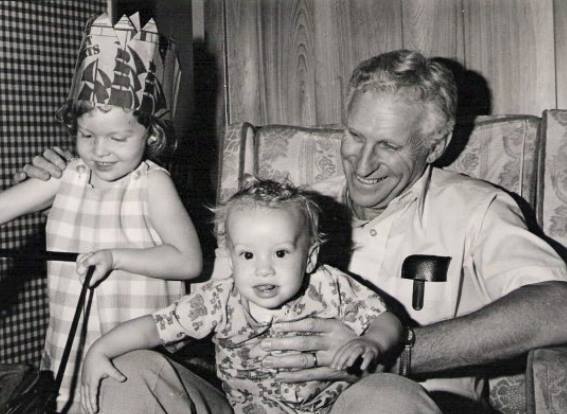
My wife had a father like that—engineer, Dale Carnegie graduate, never came out of the room without being dressed for work at the mill. No complaining, no excuses. If it’s hard, overcome it. If it’s broken, fix it. If you can pay for it, it isn’t a problem. We’re in this world to do for others, not ourselves.
My father in law, Forrest Johnson, with my two oldest girls.
These two men, along with a pretty long list of men who “fathered” me in sports, church and school, grandfathers and neighbors and Sunday School teachers, fathered me. “Fathering,” to me is this: you take responsibility for the people you love.You protect the weak. You help and defend the helpless. You stand up for what’s right and mend what’s wrong.
Fathering means helping little boys and girls know what a good man acts like. It means sacrificing, working, helping and coaching. It means helping them grow up when you’re still growing up yourself. It means doing whatever you can for your children because they come first.
If you had a father, and if you’re functional, you did. Even if that father wasn’t your biological Dad. If a man adopted you, looked Continue reading “If You Had A Father….”
Last week my wife and I attended the annual Tom and Marla Corts lecture at Samford University, where Philip Yancey was the speaker. To those outside the religious world, Yancey is one of those writers that reaches past the normal barriers to speak to the pain of a hurting world. He spoke from the substance of his newest book, which I bought and look forward to reading as soon as I can, entitled Vanishing Grace: What Ever Happened to the Good News? Yancey writes in such an engaging, thoughtful and undefensive style that he touches those who wouldn’t necessarily listen … Continue reading Grace in An Ungrace World


 The Flatpickin' Pilgrim's Progress