Start Young

If you don’t know who Ricky Skaggs is, then you really don’t know anything about bluegrass and old-time music. It’s important to distinguish those two terms. “Bluegrass” technically didn’t exist before the 1940s. It was literally invented as a form by Bill Monroe, recasting the traditional old time music of his Kentucky and Appalachian roots with a new sound built around his unique mandolin playing. The mandolin took a new role as a centerpiece performing lead instrument inMonroe’s vision. He was truly a unique American music phenomenon. Monroe inspired an entire generation of musicians and his influence lives on in … Continue reading Start Young

Exploring the Discography of Life

“…there is a playful randomness about what we find and read.  Or rather, what finds us”

When I first rekindled my interest in songwriting and music again, sixteen or seventeen years ago, I began hanging out in music stores, playing the guitar again and digging out songs from my memory and on faded notebook paper from years ago.  One day, a worker in the store I frequent most, Fretted Instruments of Birminghm, said, “Are you just starting to explore the discography?”  I had just said that “I was getting into bluegrass music” and that was his reply.

I began to delve into just that—listening, going to shows, scooting to Nashville now and then.  I bought a collection of Bill Monroe’s music.  Over the coming years, I heard a lot of music live—Bruce Hornsby, Ricky Skaggs, Nickel Creek, J. D. Crowe, Earl Scruggs, Vince Gill, as well as a lot of lesser-known but excellent players and singers coming through the Station Inn in Nashville or here in Birmingham, Continue reading “Exploring the Discography of Life”

Jim Hurst Can Play a Guitar

Jim Hurst picks.  He came dangerously close to Herb Trotman's "10,000 note limit"
Jim Hurst picks. He came dangerously close to Herb Trotman’s “10,000 note limit”

Last night, I went to hear JIM HURST, IBMA (International Bluegrass Music Association) Guitarist of the Year.  That means he is a fast-pickin’ guy.  “Bluegrass,” like few other labels, can lock you in.  The people who love and adore it who are more on the “traditional” side (Has to be like Bill Monroe and Earl Scruggs played it or it ain’t bluegrass) will leave you for growing, experimenting and deviating.  The rest of the music listening world (Country, whatever that is anymore, sheesh!), folk, indie, etc. is disinterested because they never get beyond stereotypes like “Deliverance” and the Beverly Hillbillies. Continue reading “Jim Hurst Can Play a Guitar”

Doug, Doc and Earl…Bluegrass Breakdown and Cry

The Darling Boys are no more This has been one of the unkindest of years in acoustic music.  First, Earl Scruggs, the Founding Father of bluegrass banjo, passed away (read my post on Earl’s death here CLICK)  back in March.  Then a few weeks ago, Doug Dillard, a rollicking banjo player who blazed a trail with the banjo across genres in the 1970s when he left the Dillards to join Gene Clark of the Byrds to form Dillard and Clark. Of course, you’d know old Doug for another reason, if you ever watched the Andy Griffith Show.  He was the … Continue reading Doug, Doc and Earl…Bluegrass Breakdown and Cry

Farewell, Earl Scruggs, and Thank You

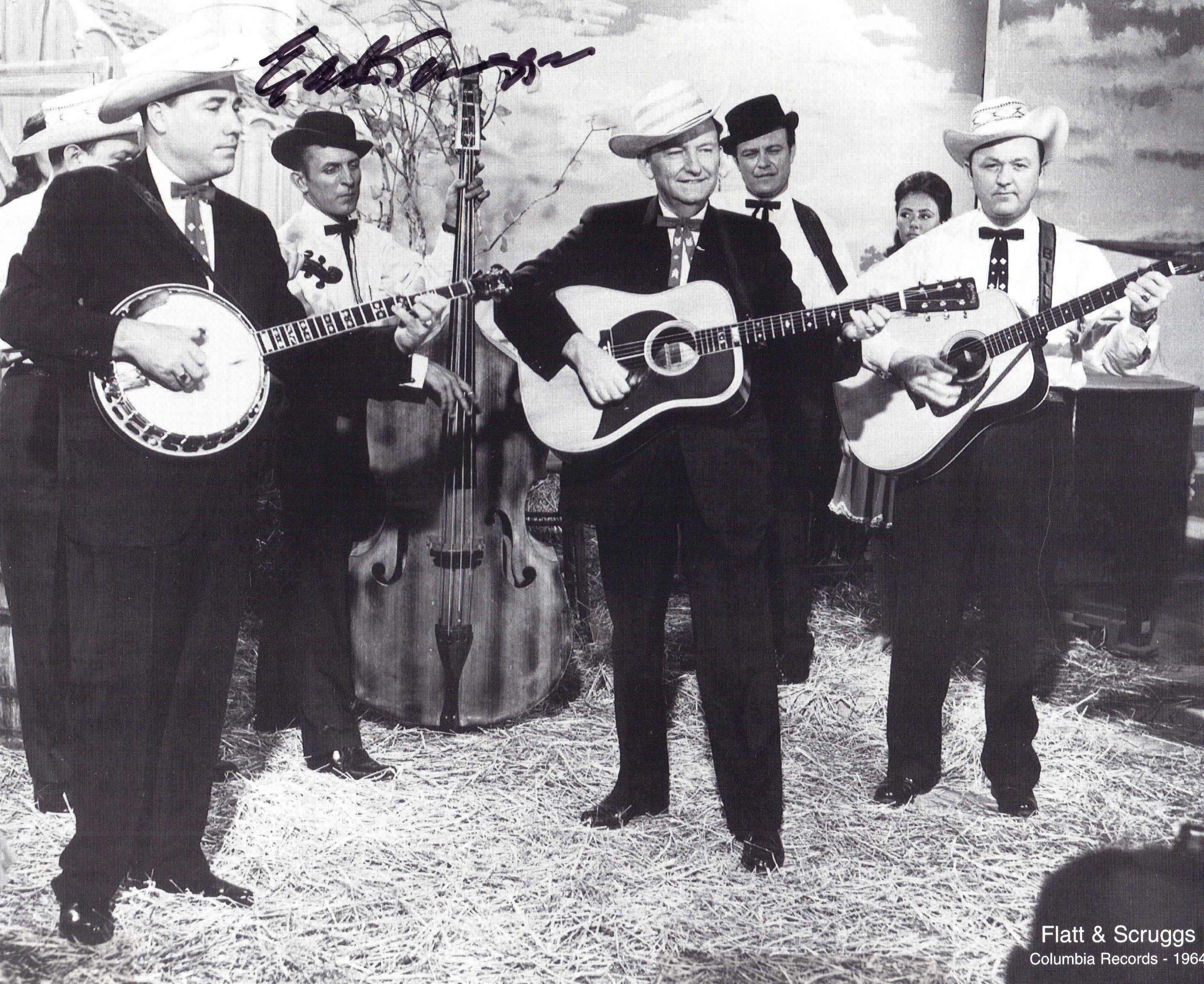
1964, on top of the world, with Lester Flatt

Earl Scruggs, “pioneer” as the Huffington Post put it,  of the Three-finger Banjo style, has died.  For some of us, he has been a mentor and inspiration our whole lives.   He was not merely a pioneer, he was the King.  And there are many legends on the banjo–Bela Fleck, Ralph Stanley, Jens Kruger, Don Reno, J. D. Crowe, and many greats.  But no one like Earl.

As a displaced North Carolina boy moving around the country, my Dad kept me connected to music.  He had a Silvertone electric guitar from Sears and a Harmony archtop acoustic guitar.  The electric would shock you if you played in bare feet on the garage floor so I tended to play the acoustic.  I didn’t know much about Earl Scruggs, but I kept running into him over the years.

When we moved to Irving, Texas in the late Sixties, I learned to play very slow rhythm guitar to a very slow “Foggy Mountain Breakdown” and “The Ballad of Jed Clampett” (LISTEN) with my seventh grade friend,  Brad Phillips, who was the odd combination of a banjo playing Episcopalian. Continue reading “Farewell, Earl Scruggs, and Thank You”