Exploring the Discography of Life
Subscribe to continue reading
Subscribe to get access to the rest of this post and other subscriber-only content.
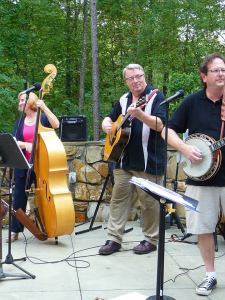
“The genetic code of bluegrass and old time music is more sophisticated than that. It carries stories of birth, life and death in the old days. It tells of children dying young, tragic love, shame, murder, alcoholism and faith. To learn the code, no stereotype will do. You have to descend into the music and listen.”
In 2005 I took a three month sabbatical to study, pray, and feed the senses. I went to art museums, read books, went to Nashville to learn about the music industry and played at open mic at the Bluebird Café, reaching one
Shuffler and Boosingerof my bucket list items (the ultimate would be a gig on the “Prairie Home Companion Show” while Garrison Keillor is still on earth!). But a lot of that time was “exploring my roots,” musical, theological and spiritual—which led to a week at Steve Kaufman’s Acoustic Kamp.
I’d been to the Kamp before, in Maryville, Tennessee. Unless you are a devotee of the guitar and acoustic cousins like the mandolin, the “fiddle” (violin played a certain way), bass, banjo or dobro, you don’t realize that hundreds of camps happen every year across the world where musicians gather and play and learn the heritage of “roots” music—folk, jazz, country, celtic, and so on. In these places, campers rub shoulders with the legends of bluegrass, swing, fingerpicking and new acoustic music. I met legends like Bill Keith, Clarence White, Continue reading “Mapping the Bluegrass Genome”
“J——, this is your pastor. Now having heard your
confession on the air, will you stop by to receive
penance instructions about being a better father and husband?”
It’s just too easy to weigh in on the comments of Mike Francesca and Boomer Esiason about Daniel Murphy’s decision to take two days to be present for his baby’s birth.
Of course, we live in a time of sportainment. More and more, as politics becomes hopelessly unresponsive and global problems impinge on every part fo life, sportainment is the way we escape–from real life. Except that ultimately isn’t an option.
One day I listened in on sports radio–I admit, it’s a guilty pleasure on the way to the hospital or a meeting, in part because I will always laugh at something pretentious, silly or absurd. And much of what is discussed is fun to consider. A husband caller complained to Paul Finebaum about a player’s tweet after Alabama lost its bowl game that “it’s only a game.” His argument was that it isn’t. He went on, passionately, to say that though he was a member of a church and loved his family, that during the football season he spends more time and money on the sport than on his wife and kids or his church.
My jaw dropped since I am a minister, but why should it? I like to imagine that I might follow up crazy calls. What would I say? Disguised voice: “This is Dr. Hapner Wogwillow. I am a marriage therapist. I treat his wife for depression and recognized him in the call. He needs to go home. She just left for good with the kids. I will tell him their names if he’ll call me. BR-549.” My other idea was to, “J——, this is your pastor. Now having heard your confession, will you stop by to receive penance instructions about being a better father and husband?” Continue reading “Daniel Murphy, Sports and Babies”

Johnny Cash died on September 12, 2003, going out in a blaze of recording glory with his last work, four albums titles “American I-IV”. Ever experimenting and interacting with the musical world, the series, produced with the help of Rick Rubin, was highly acclaimed. “Hurt,” and the accompanying video, appearing three months before June’s death and seven before Johnny himself succumbed to diabetes.
The brilliant video serves as a summary and eulogy for the man in black. But apparently it was not the end of his recording career. This week the world is meeting the music of Johnny Cash once again. “Out Among the Stars,” a never-released album of songs recorded in 1984, was unearthed by his son and released to the public. I just got it and am listening through.
Looking at a newborn is a pretty overwhelming reality. It is the age we are in. Vickie and I were sitting outside in the
waiting room, getting more anxious by the moment for our daughter and her husband and a little one. Being born is
dangerous, not guaranteed, and full of anxiety, no matter what reassurances we are given. In fact, the greatest advice from the OB to our daughter the last two months was, “Don’t Google.”
We don’t know how to know what to do with all the information. In the old days, they took the mother, the father paced outside, and the baby arrived. It was the first inkling of what you had—boy or girl. No paint colors until you knew.
Now, you have more knowledge about this infant than the NSA has of your cell phone. But what to make of it? Truth is, there is still a place where we cannot intrude with knowledge, and it is the miracle of life itself.
But don’t get me wrong. It’s great to know. And here’s how we got the word. We’re sitting there, grandparents, waiting, worrying, praying. Getting texts from our kids and friends—praying for you, hoping, let us know, that sort of thing. And we occupy ourselves by answering these as we wait. Naturally, we are watching the other occupants of the room. A waiting room is pure democracy. Rich, poor, well-dressed and barely dressed, country and city, every Continue reading “Asking Good Questions: A Sermon for a Young Parent”