Visitor to Virgin Pines

Scene from the movie

I have dipped my first toe into soundtrack creation for a movie.  My bandmate, Greg Womble, has written and produced a beautiful short Christmas film and is in the final edit stage of his short Christmas film, “Visitor to Virgin Pines.”

Our band was invited to do music for it, and I have to say, it is one of the most interesting undertakings I have ever done.  Mostly late at night, I sat with a banjo, guitar, mandolin, even percussion, and tried to create “moods” for scenes.  I have enormous appreciation for what people who do this face.  And yet, it is joy to do it.  I came up with some really nice instrumental stuff, not all of it chosen for the musical, but which may land in a Christmas CD.  Here’s a piece I did on the banjo called “Sugarplum Ferries” (yes, I know.  I spelled it the way I wanted to–I had the image of little boats going back and forth loaded with goodies).   “Sugarplum Ferries” Continue reading “Visitor to Virgin Pines”

Banjo Harmonies

The truth is, the banjo, like all the indigenous music of the South, is another of those curious shadowy meeting places of black and white people. Surely by now you’ve seen that bumper sticker that says, PADDLE FASTER—I HEAR BANJOS PLAYING.  It’s an allusion to the worst movie for the banjo’s image since the minstrel era—“Deliverance.”  Despite the wonderful “Dueling Banjos” song, which was written by the talented Arthur Smith, whom I used to watch on TV from Charlotte, NC as a boy (and who also wrote the “Guitar Boogie.”), it was an image I’d as soon forget. The banjo … Continue reading Banjo Harmonies

Doc, Doug and Earl…Bluegrass Goodbyes

A few days ago, I wrote about the too-soon loss of Doug Dillard, an extraordinary banjo player who was a bridge figure between Bill Monroe and the “pure bluegrass” (which is itself an irony, since Monroe was actually an innovator himself.  He took a hodgepodge of what is ssometimes called “old time music,” consisting of fiddle tunes for dancing, old folk tunes, blues and other music that flowed from Appalachia and the south and forged a unique sound dominated by the mandolin and banjo and fiddle.  He was not beyond experimenting himself, even bringing an accordion in a time or … Continue reading Doc, Doug and Earl…Bluegrass Goodbyes

Doug, Doc and Earl…Bluegrass Breakdown and Cry

The Darling Boys are no more This has been one of the unkindest of years in acoustic music.  First, Earl Scruggs, the Founding Father of bluegrass banjo, passed away (read my post on Earl’s death here CLICK)  back in March.  Then a few weeks ago, Doug Dillard, a rollicking banjo player who blazed a trail with the banjo across genres in the 1970s when he left the Dillards to join Gene Clark of the Byrds to form Dillard and Clark. Of course, you’d know old Doug for another reason, if you ever watched the Andy Griffith Show.  He was the … Continue reading Doug, Doc and Earl…Bluegrass Breakdown and Cry

Farewell, Earl Scruggs, and Thank You

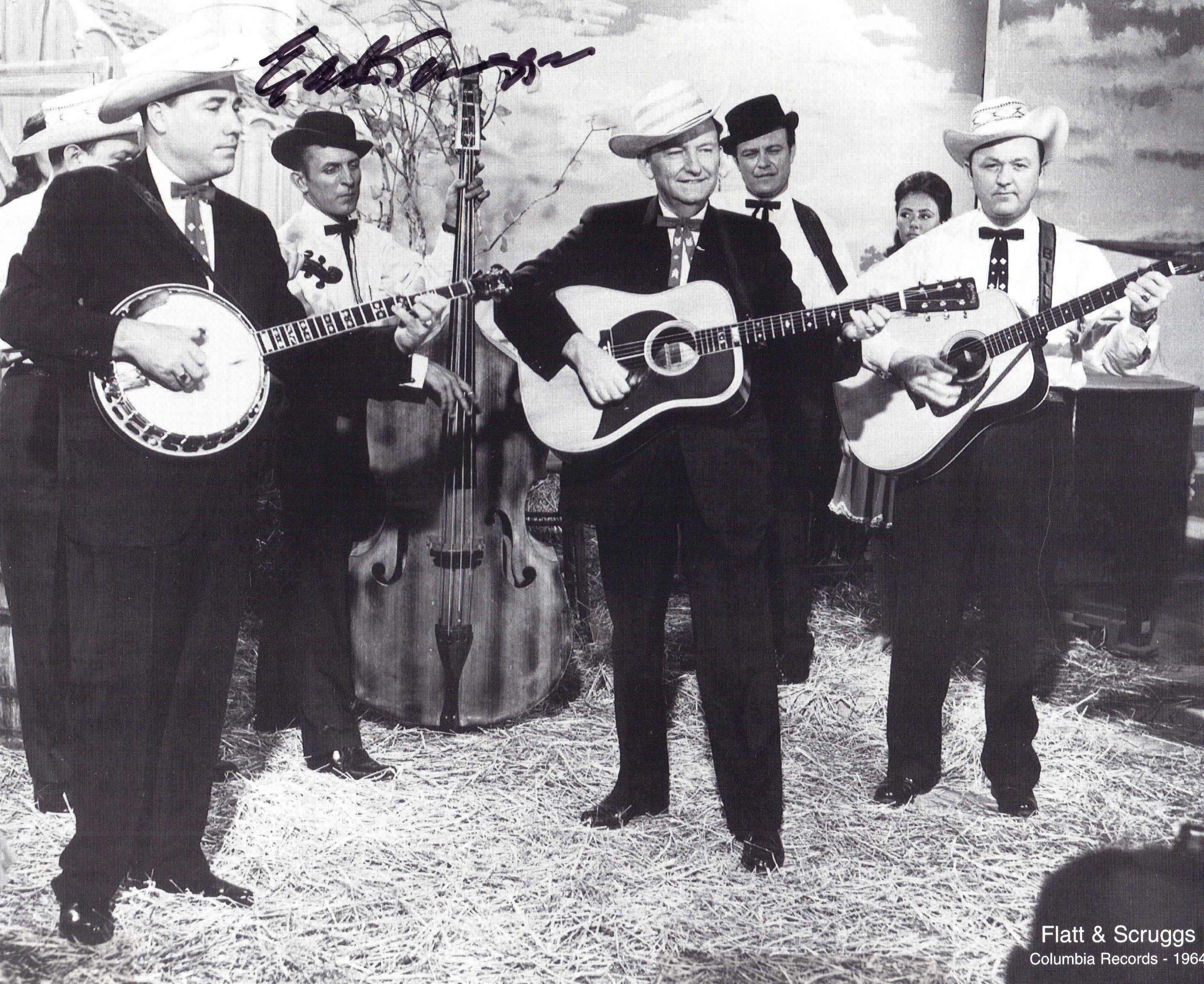
1964, on top of the world, with Lester Flatt

Earl Scruggs, “pioneer” as the Huffington Post put it,  of the Three-finger Banjo style, has died.  For some of us, he has been a mentor and inspiration our whole lives.   He was not merely a pioneer, he was the King.  And there are many legends on the banjo–Bela Fleck, Ralph Stanley, Jens Kruger, Don Reno, J. D. Crowe, and many greats.  But no one like Earl.

As a displaced North Carolina boy moving around the country, my Dad kept me connected to music.  He had a Silvertone electric guitar from Sears and a Harmony archtop acoustic guitar.  The electric would shock you if you played in bare feet on the garage floor so I tended to play the acoustic.  I didn’t know much about Earl Scruggs, but I kept running into him over the years.

When we moved to Irving, Texas in the late Sixties, I learned to play very slow rhythm guitar to a very slow “Foggy Mountain Breakdown” and “The Ballad of Jed Clampett” (LISTEN) with my seventh grade friend,  Brad Phillips, who was the odd combination of a banjo playing Episcopalian. Continue reading “Farewell, Earl Scruggs, and Thank You”