The Artist and the Editor

There is a time for the Artist and a time for the Editor The Editor worries about the audience, sales and attracting attention to the finished product The Artist tries to listen to the deep, deep truth within, unfiltered and unfettered The Editor wants it to be the best it can be and to have a chance to be heard. The Artist wants the work to be true to what it was the first time she heard it The Editor is outside the Artists heart and mind and often doesn’t “get” the artist’s vision The Artist cannot leave himself and … Continue reading The Artist and the Editor

“Blue Like Jazz”: Not Your Father’s Evangelical Movie

 “Blue Like Jazz” arrived at selected theaters this past week, an odd stepchild among usual movie fare of aliens, vampires, and things that go boom.  Derived from Donald Miller’s book by the same name, “Blue Like Jazz” is a story of life and faith during a young man’s first year of college.  Don, the main character, is son of a bible believing single mother who wants to protect her son and an atheist  father who is emotionally disconnected, mostly absent, and religiously hostile.

Donald’s Dad wangles an acceptance from Reed College in Portland, Oregon, a school filled with intellectually brilliant and morally unfettered not-quite-adults.  After struggling with it, he heads to Reed and Portland instead of the Baptist college his mother wants him to attend.  Soon life is filled with Political Correctness, drugs, booze and moral haze.   The professors challenge every aspect of life, and students engage in protest and outrageousness as an extracurricular activity.

From that point we follow Don as he struggles with the pain of the life he has left behind but the faith that won’t leave him alone.  He is ashamed of that identity, and tries to fit in, but never really does.  The church is an ambiguous presence throughout the movie.  The childhood church that Don leaves behind is a stereotype of tacky children’s sermons and fear of the world.  The youth pastor is glib, a know-it-all, self-assured, and, it turns out, secretly sleeping with Don’s mother, which brings a crisis into his life later in the story. Continue reading ““Blue Like Jazz”: Not Your Father’s Evangelical Movie”

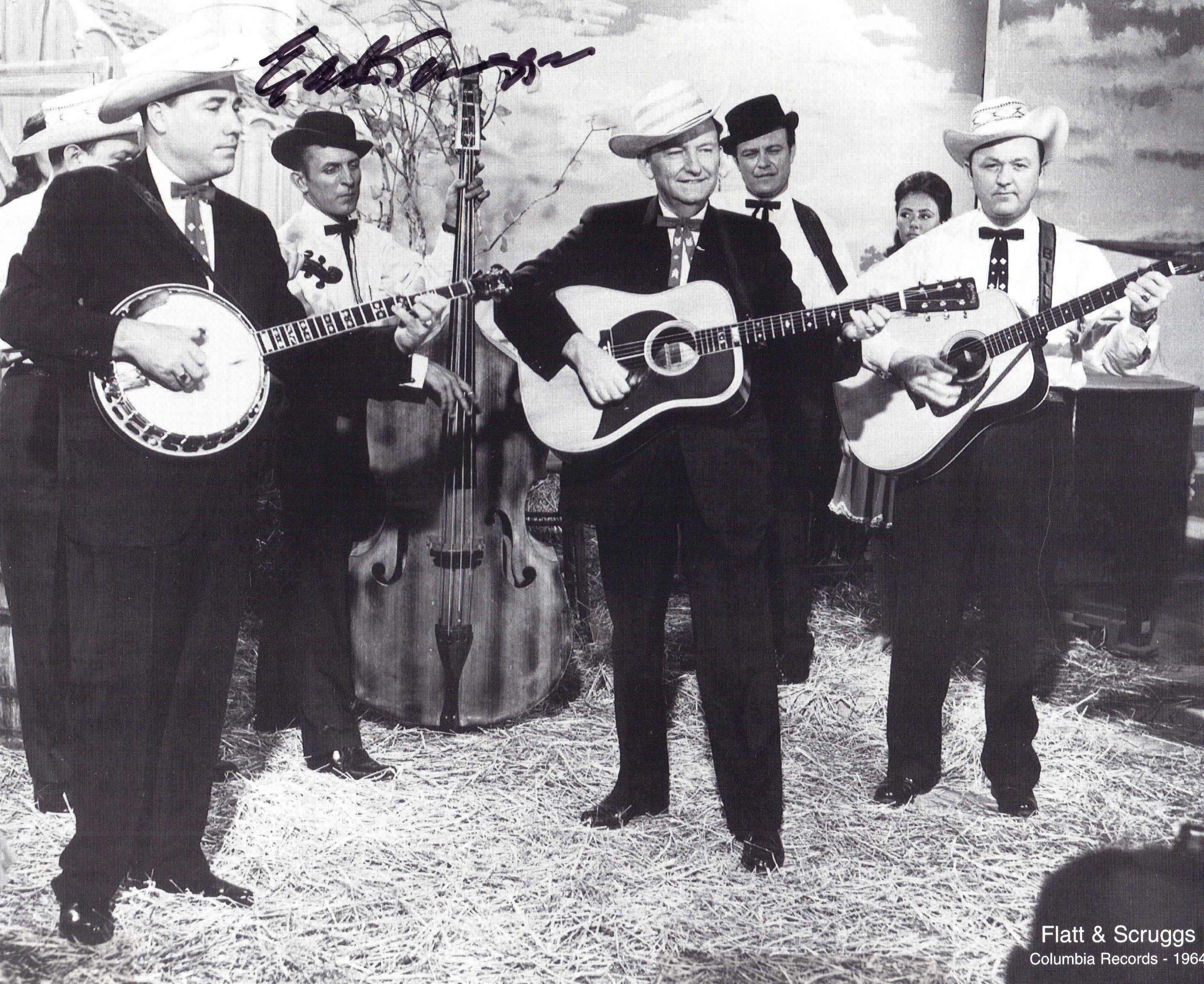
Farewell, Earl Scruggs, and Thank You

1964, on top of the world, with Lester Flatt

Earl Scruggs, “pioneer” as the Huffington Post put it,  of the Three-finger Banjo style, has died.  For some of us, he has been a mentor and inspiration our whole lives.   He was not merely a pioneer, he was the King.  And there are many legends on the banjo–Bela Fleck, Ralph Stanley, Jens Kruger, Don Reno, J. D. Crowe, and many greats.  But no one like Earl.

As a displaced North Carolina boy moving around the country, my Dad kept me connected to music.  He had a Silvertone electric guitar from Sears and a Harmony archtop acoustic guitar.  The electric would shock you if you played in bare feet on the garage floor so I tended to play the acoustic.  I didn’t know much about Earl Scruggs, but I kept running into him over the years.

When we moved to Irving, Texas in the late Sixties, I learned to play very slow rhythm guitar to a very slow “Foggy Mountain Breakdown” and “The Ballad of Jed Clampett” (LISTEN) with my seventh grade friend,  Brad Phillips, who was the odd combination of a banjo playing Episcopalian. Continue reading “Farewell, Earl Scruggs, and Thank You”

The State of the Union–of Love and Truth

Gary Furr

Love and truth belong together.  So why is it that they are so often found separated?  Moral life arises from the recognition of eternal truth, the acceptance of the reality of others in that same truth, and the sensitivity to feel the connection between them.  Puritan preacher Richard Baxter said love for one’s neighbor is akin to hunger and food connecting.  It makes possible a new and different conversation.

Truth and love cannot live divorced from one another.  Otherwise we are, in the former case, driven to principles rendered only as power, devoid of kindness and the graces and kindnesses of feeling for the other. Continue reading “The State of the Union–of Love and Truth”

Finding Your Voice

Gary Furr

It’s become a cliche only because it is so powerful and pervasive.  Your “voice,” I once heard songwriter Pat Terry say, is what makes people say, “That’s a Gary Furr song” or “that’s a (your name here) story.’  I have thought about this for thirty years, focused when I once, during a five day solitary retreat started to say a short prayer I had been using to center myself and blurted out, “Father, help me to be myself.

If that sounds so very self-centered in our culture already so “you-can-be-whatever-you-want-to-be,” permit me to observe that despite our coaching of selves and self-focus I sure meet a lot of broken ones out there in life.  People wounded and held back by a voice in their head:  “you’ll never amount to anything,” and somettimes not even traumatic voices–just ones we imbibe from our world.  “So many people are better than you.  What do you have to offer?  What’s the point?” Continue reading “Finding Your Voice”