Remembering 9-11

[Five years ago, I published this piece. It remains, by far, the most read piece I have ever written on here, not because of any brilliance on my part, but because of the solemnity of the event and the somber reality of loss. Since the original 9-11, the world has only underlined the pain, conflict and brokenness embodied in that day. Walter Brueggemann once wrote that before Israel in ancient times could hear God’s word, they had to grieve in order to understand what they had lost. Forgetting 9-11 dishonors that day. It was a terrible day, not in the way the deluded anarchists intended, but a day that caused the world to stop and consider itself. We should never forget the dead, one or three thousand. They have much to tell us, if we will listen. I hope this might speak to you, to all of us, as we remember today]

So what are you readers doing to remember 9-11?   A few weeks ago our church lead in a community wide presentation on a Sunday evening with joint choirs and full orchestra as a remembrance of 9-11.  It was inspiring, somber, reflective and hopeful.  I expect that this year will be an especially somber time for our nation as we mark a decade since that terrible day.  It has been one of the most challenging decades of our nation’s history.

One of the most intriguing books I have read in recent years is Rodney Clapp’s Johnny Cash and the Great American Contradiction.  It really is not, mostly, a book about Johnny Cash.  It is about the religious, cultural and political ambiguities of the American psyche that were embodied in the life of Johnny Cash.  One of the points he made was that whereas the center of community life in New England was the public square, as expressed in the parade, in the South, the center of life became the church, and the great public event was the revival.

The result of this caused the church to bear all the weight of life, public and private.  It was the center of its members’ lives in a way that did not play out the same in the Northeast.  Therefore, patriotism also had to find its way into the church and live there.  I have thought about this a great deal since reading it, wondering if we do not suffer greatly from the diminishment of shared public life so well-chronicled in recent years.  More and more, we live disconnected from our fellow citizens, isolated into interest groups, religious ghettos and our homes with their entertainment centers.  It’s hard to get us all together.  Even churches need to get out in God’s wider world sometimes…

In 2009, I saw Washington, D.C. for the first time in my life (I know, how DID it take so long!).   I was truly inspired by the experience.  In these cynical times, it is hard to find places to connect to a larger sense of e pluribus unum anymore, but looking at the Lincoln Memorial , close to the spot where Martin Luther King called us to our better selves, I felt something powerful in my heart.  I looked up at the tragic, larger than life statue of President Lincoln, and Continue reading “Remembering 9-11”

Faith Amid Many Faiths

Religion is in the news every day, and sometimes the way politicians and news reporters talk about it

shows an enormous ignorance.  Religious faith as the media and politicians talk about it sometimes bears little resemblance to the daily lives of billions of faithful people across the world. We live not only next to Muslims, but Buddhists, Hindus, Jews and many others.  Sometimes this diversity is seen as a threat.  But how do we respond?

Most Christians are not hateful or uncaring to their neighbors. But in these fear-driven times, some truth is a welcome friend.  In this study, we will learn a little more about two “neighbors” with whom we share similar ancestry through Abraham—Islam and Judaism—and how Baptists can draw from their heritage to find a way to a more thoughtful and faithful interaction with others.

First, we are affected powerfully by what I have come to call “un-socializing media.”  The web has made powerful and wonderful goods to be available to the planet.  Unfortunately, it also provides terrible temptations and problems.  I’m not simply talking about terrorists and pornographers being able to spread their poison, though that is bad enough.  But the damage of half-truths, uncritical forwarding and the anonymity of the internet enables people to “express” things better left to the Continue reading “Faith Amid Many Faiths”

Another Day of Terror: Holy Week Reflection

I woke up to the bad news from Brussels, Belgium today. We are so numbed to the violence on our globe, we have to wonder about the ambivalent gift of “information.” There is no time to digest, reflect, pray, consider. We are, instead, an endless echo of bad news cycles, compounded by the “unsocial media” that encourages the worst among us to speak loudly even if it is unworthy to hear. Here is the reflection I sent to my congregation today:


The recurring horror of terrorism is found in the terrorists themselves.  They are, finally, demented haters of life, of humanity, of our collective existence—that is the essence of terrorists’ acts. There is nothing in them but absolute despair of hope, and the desire to destroy it in all others for the sake of fantastic delusions of forcing the hand of the universe to bend to their will. There is nothing at the end oftheir action except death and blood.

They are not new. Throughout all of history, they have killed, as governments and society seek to kill them in response. On and on the fatal disaster continues, hopelessly. It is into Holy Week that the latest delusion happens. In Brussels the fanatics strike civilization once more, convinced that they will prevail, and destined absolutely to fail.

Of all weeks, this one should comfort those who believe in Christ Jesus. Of all people, we began in a story of unjust death, amid terrorists who led people into the desert (Acts 21:38) and to the top of Masada only to die for nothing and their hopes dashed. Those who waved the palms would flee for their lives—and for what? The emptiness of a lost cause. Continue reading “Another Day of Terror: Holy Week Reflection”

Pat Terry and the Eye of the Artist

 If we learn to look at life with the eyes of the artist, we

will see an entire universe that is “a gift of mercy.”

Workshop
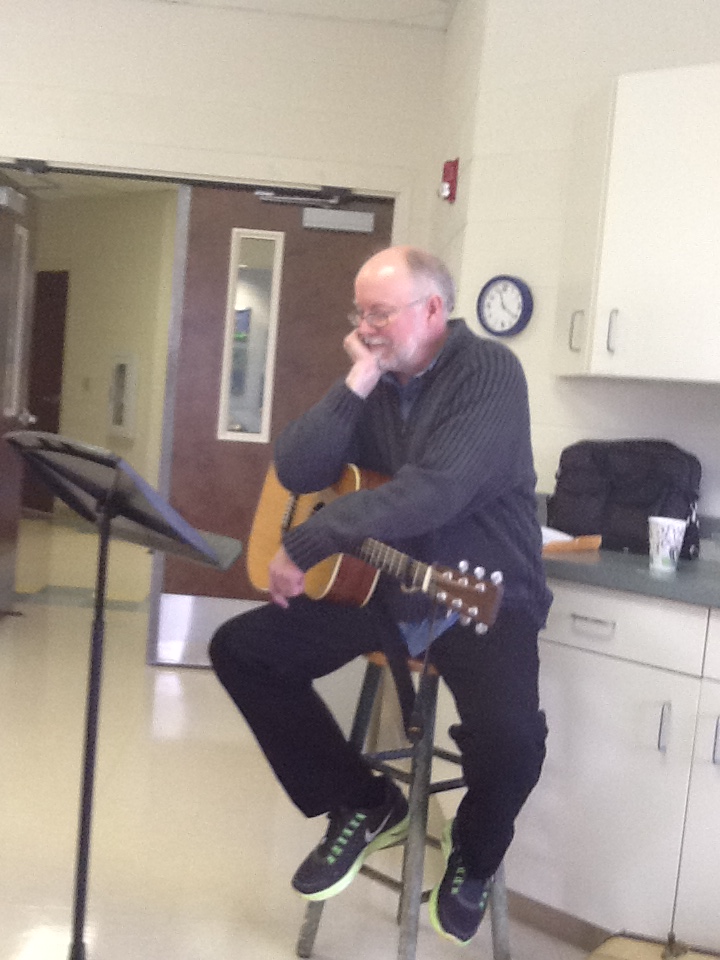
Pat pondering how to help a workshop participants song

It’s odd that a musical preacher who writes songs, cut his teeth and got called to ministry during the Jesus Movement of the 1970s would have met Pat Terry so late in life, but that’s the way life winds sometimes.  I had heard of the Pat Terry group back when he was starting out—Pat is just a bit older than me.  I heard his songs, but my musical journey got put on hold for a long time as marriage and children and years in graduate education and pastoral ministry took me in different directions.  I continued listening to music and playing and singing, sometimes in church and mostly by myself for my own pleasure.

Pat Terry, meanwhile, was on a journey of his own, too.  After many years, first in the very spontaneous and joyful Jesus Movement musical world, and then for a while in the increasingly industry-captivated contemporary Christian musical world, he moved on.  He had a good, long run as a commercial songwriter in Nashville, with a string of songs for many well-known artists like John Anderson, Travis Tritt, Kenny Chesney, Alan Jackson, Tanya Tucker and the Oak Ridge Boys.  He learned the Nashville craft and all the while continuing his own inner journey of writing from the heart.

So it was that a few years ago, Greg Womble, my friend and bandmate who plays the banjo publicly, and I, who play it out of earshot but love it, went to Atlanta to Continue reading “Pat Terry and the Eye of the Artist”

War of the Worldviews?

Stephen Prothero, a Boston University religion scholar, wrote an opinion piece for CNN in the aftermath of the horrendous mass murder in Norway by suspect Anders Breivik.  Breivik set off a bomb and then, disguised as a policeman, infiltrated a youth camp where leadership and politics are taught and opened fire, at this point claiming at least 76 deaths. Breivik is white, Christian, and released a bizarre 1500 page manifesto in which he advocated a revolution in which the cultural dominance of Christianity might prevail over what he saw as an “Islamic-Marxist” alliance.  He wanted to speak on television in … Continue reading War of the Worldviews?